Join CafeMom Today! Autism Spectrum Disorder: Treatments

Wednesday, March 11, 2009

Spirulina: Algae for Autism

One mother used spirulina to reversed the signs of autism in her son

Wikipedia on Spirulina ...

Protein

Spirulina contains an unusually high amount of protein, between 55% and 77% by dry weight, depending upon the source. It is a complete protein,[citation needed] containing all essential amino acids, though with reduced amounts of methionine, cysteine, and lysine when compared to the proteins of meat, eggs, and milk. It is, however, superior to typical plant protein, such as that from legumes.[4][5]

Essential fatty acids

Spirulina is the common name for human and animal food supplements similar to Chlorella and Aphanizomenon flos-aquae (Blue Green Algae.) Spirulina comes from two different species of cyanobacteria: Arthrospira platensis, and Arthrospira maxima. These and other Arthrospira species were once classified in the genus Spirulina. There is now agreement that they are a distinct genus, and that the food species belong to Arthrospira; nonetheless, the older term Spirulina remains the popular name. Spirulina is cultivated around the world, and is used as a human dietary supplement as well as a whole food and is available in tablet, flake, and powder form. It is also used as a feed supplement in the aquaculture, aquarium, and poultry industries.

Spirulina is rich in gamma-linolenic acid (GLA), and also provides alpha-linolenic acid (ALA), linoleic acid (LA), stearidonic acid (SDA), eicosapentaenoic acid (EPA), docosahexaenoic acid (DHA), and arachidonic acid (AA).[5][6]

Vitamins

Spirulina contains vitamin B1 (thiamine), B2 (riboflavin), B3 (nicotinamide), B6 (pyridoxine), B9 (folic acid), vitamin C, vitamin D, and vitamin E.

Related:

Wednesday, March 4, 2009

A Dynavox Autism Success Story


The following is from a mom per my request for Dynavox and Autism Success Stories. We are getting more out of the Dynavox daily and have been using it to play games as a family. It is truly a great tool, but a lot of work.

My daughter got her Dynavox V about three years ago this coming May. I have to agree that programming it is a lot of work. We have four people assisting us with using the device and programming it. We have our SLP, our Dynavox consultant/trainer, our daughter's aide and me....mom. I've spent up to nine hours in one day just on programming. It has been very useful in many situations like going on vacation, going to the doctors office, going to the dentist and/or orthodontist. She uses it to tell me what she did at school today and what she worked on for the day. We also use it for helping her to remember all the steps with setting the table, ordering at restaurants, grocery shopping and using a list, using the ATM machine, and many many other things. She uses it to play games as well...solitaire is one of her favorite games. We are always thinking of more way to use it.

However, I think the biggest drawback is it's portability. It's very heavy and isn't easy to lug around school all day. It's not real practical during PE because of it's size and weight. My biggest recommendation would be for Dynavox to find ways to improve the size and weight of the device to improve it's portability. It would also be nice if the black carrying case had a built in pouch for the white dynavox pen.

Anyway, I could write a lot more but just wanted to give a little feedback on our experience with the device.

Friday, February 27, 2009

No Limits 2 Learning


The No Limits 2 Learning Blog has been added to the Augmentative and Alternative Communication blog feeds on the left sidebar.

Tuesday, February 24, 2009

Prozac for Autism - Fluoxetine not effective

Autism Speaks Announces Results Reported for the Study of Fluoxetine in Autism (SOFIA) First Industry-Sponsored Trial for the Autism Clinical Trials Network (ACTN)

NEW YORK, N.Y. (February 18, 2009) – Autism Speaks today announced initial results reported for the first industry-sponsored trial of the Autism Clinical Trials Network (ACTN), the Study of Fluoxetine in Autism (SOFIA). These results showed that fluoxetine was not effective for reducing repetitive behaviors in children and adolescents with Autistic Disorder as compared to placebo (non-medicinal sugar pill).

The study was carried out in collaboration with study sponsor, Neuropharm Group Plc., a specialty pharmaceutical company focused on neurodevelopmental disorders.

The study evaluated the efficacy and safety of Neuropharm's new low-dose form of fluoxetine, known as NPL-2008, which is designed specifically for the treatment of Autistic Disorders in children and adolescents. NPL-2008 uses the Zydis® melt-in-the-mouth formula, intended to be an easier form of the medication for children. The study showed that repetitive behaviors were reduced when children were given either NPL-2008 or a placebo, but no differences between groups were found in terms of the level of reduction of repetitive behaviors. Thus, it was concluded that NPL-2008 was not more efficacious than the placebo. The new formulation was generally well tolerated by patients and no serious adverse events were reported.

Geraldine Dawson, Ph.D., Autism Speaks' Chief Science Officer remarked, "The development of effective drugs that are easily taken by individuals with autism is an important goal. While it is disappointing that NPL-2008 was not found to be effective for reducing repetitive behaviors, this study does highlight the importance of high quality, rigorously controlled clinical trials. Studies like this help build the evidence-base and offer parents guidance in making more informed decisions about their child's clinical care."

The Autism Speaks ACTN was launched in 2005 to address the need for more thoroughly tested biological treatments for autism. The ACTN provides a platform to rigorously test the safety and efficacy of existing compounds, most of which do not have specific indications or specific dosing instructions for their use in autism. These treatments are prescribed by medical practitioners for "off-label" use.

Fluoxetine is one of the most widely prescribed central nervous system (CNS) drugs for disorders such as anxiety, depression, and obsessive-compulsive disorder. It has been prescribed "off-label" by physicians to alleviate repetitive behavioral symptoms in autism. Smaller studies in children and adults showed promising results, but there had not been a large scale study of this type to systematically confirm the efficacy of the drug for reducing these behaviors in autism. Currently, there is only one treatment with a specific FDA-approved indication for autism, but it does not target the core symptoms of autism.

The SOFIA study is the largest trial ever conducted in patients with Autistic Disorder. The study was carried out across 19 ACTN medical centers and clinical sites throughout the US. A total of 158 patients between the ages of 5 and 17 were enrolled into the SOFIA study in which patients received either NPL-2008 or placebo during a 14 week treatment period. The full analysis of the primary and secondary data from the study is ongoing.

Peter Bell, Executive Vice President for Programs and Services commented, "Finding safe and effective medications that treat the core symptoms of autism is one of the greatest challenges facing our community. One of our primary goals at Autism Speaks is to help identify effective treatments that lead to improved quality of life for all those affected by autism."

Robert Mansfield, Neuropharm's CEO, stated "These initial results are both unexpected and disappointing, and we await the results of the full analysis which is currently ongoing. We would like to thank Autism Speaks' Autism Clinical Trials Network who facilitated the timely completion of this study and to thank the teams at the sites involved in SOFIA."

Related:

Thursday, February 5, 2009

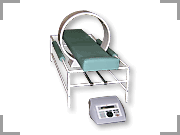
Pulsed Electromagnetic Field Therapy (PEMF) and Autism


University of New York has shown a special version of PEMF called transcranial magnetic stimulation (TMS) to promote the growth of new neurons in areas associated with learning and memory. "The effect on the stem cells is the most exciting finding," says Battaglia, who presented his results at a meeting of the American Academy of Neurology in Boston.

FULL ARTICLE

Related:

Monday, February 2, 2009

Neurofeedback for Autism = Promising Results: 1 Year Followup

A One Year Follow Up of Neurofeedback For Autistic Spectrum Disorders

This current report extends the initial findings of “Neurofeedback For Autistic Spectrum Disorders: Promising Results In A Small Sample” to a 1 year follow-up of the same participants with Autism Spectrum Disorders (ASD). Recall from the initial study that participants with ASD experienced statistically meaningful improvements in a variety of executive functioning, social, and behavioral areas following 40 neurotherapy sessions.

[FULL ARTICLE]

Wednesday, January 28, 2009

Dynavox for Autism Success Stories


We have been using the Dynaxox for a couple of months now and I must say that it is a lot of work. It's a great device and does give our daughter the ability to communicate. I would love to hear from some of you that have had success with this or a similar device. Drop me a line at autism.parent@gmail.com and share your story.

Speaking Of Dynavox


The Dynavox "Speaking Of" Blog has been added to the Augmentative and Alternative Communication blog feeds on the left sidebar.

Wednesday, January 7, 2009

Chelation: Is it safe?

Chelation: Not as safe as we’ve been told

Practitioners that promote the “biomedical” treatment of autism often claim that there is little risk of harming an autistic child with the interventions they recommend. “What’s the harm of trying?”, they ask; “What have you got to lose?”

As it turns out, the answer to that question may be “Quite a bit.” Apart from the cost in terms of money, time, effort and false hope, it now appears that one of the prominent “biomedical” treatments for autism may cause neurological damage.

In November, 2008, the journal Neurotoxicology released an “e-publication” of an article that casts further doubt on the efficacy and safety of chelating children with autism.

[FULL POST]

Source: A Photon in the Darkness


Labels

420 (1) AABA (1) AAT (9) ABA (27) Abilify (2) Acamprosate (1) Acupuncture (2) Adeli Suit Therapy (1) AEIOU Early Intervention (1) Afinitor (1) AIT (3) Algae (1) Alzheimer's Drugs (2) Amantadine (1) Amino Acids (1) AMMT (1) Anat Baniel Method (1) Animal Assisted Therapy (15) Anti psychotics (2) Anti-convulsants (2) Anti-fungal therapy (1) Anti-yeast therapy (2) Antibiotics (1) Antidepressants (7) Antioxidants (1) Antipsychotics (2) Applied Affectionate Behavior Analysis (1) Applied Behavioral Analysis (26) Arbaclofen (1) Art Therapy (9) Assistive Technology (18) Athletics (1) Audio-Visual Entrainment (1) Auditory Integration Training (3) Auditory Motor Mapping Training (1) Augmentative Communication (17) Autism (7) Autism Clinical Trials Network (1) Autism Fun (2) Autism Treatments are Expensive (11) Autism360 (1) AVE (1) Baclofen (2) Bacteroides (1) BCAAs (1) BDNF (1) benzodiazepine (1) Better Diagnosis (1) Biofeedback (9) Biomedical Treatments (4) Brain Plasticity (1) Branched Chain Amino Acids (1) Bumetanide (1) Bumex (1) Burinex (1) Buspar (1) Buspirone Hydrochloride (1) Cannabis (7) Cerebral Folate Deficiency (1) Character Therapy (1) Cheerleading (1) Chelation (4) Chewing Gum (1) Chiropractic (1) Cholesterol (1) CLM (1) clonazepam (1) Coffee (1) Communication Devices (16) Competent Learner Model (1) Computers (12) Contrarian (1) Cord Blood (1) Costs of Treatment (17) CranioSacral Therapy (1) Cutting-Edge Therapies (2) Cybertherapy (1) D-Cycloserine (1) DAN (5) Dance (1) DATS (2) DCS (1) DEFEAT AUTISM NOW (6) Detecting Autism (1) Detox (1) Developmental Individual Difference Relationship Model (3) Diagnosing Autism (1) Diet (6) DIR (5) Disco (1) Discrete Affectionate Trials (1) Discrete Trial Training (4) DNA (1) Dolphin Dome (1) Dolphin Therapy (8) Drugs (34) DTT (5) DynaVox (14) Early Intensive Behavioural Intervention (1) ECLIPSE Model (1) Ecstasy (MDMA) (1) EEG Biofeedback (7) EIBI (1) Elephant therapy (1) Enzyme (1) Epigenetics (3) Epilepsy (5) Epsom Salts (2) Equine Therapy (10) Face Recognition (1) Facial Reflexology (1) Fatty Acids (2) Fish Oil (2) Floor Time (8) Floortime (7) Fluoxetine (1) fMRI (1) Folic Acid (2) Functional Magnetic Resonance Imaging (1) Games (3) Gene Therapy (4) Genome Sequencing (1) Glutathione (1) Grace (1) HBOT (16) Hippotherapy (7) Hormones (1) Horse Therapy (11) Hydration (1) Hyperbaric Oxygen (16) Hyperinsulinemia (1) Hypnosis (1) Hypnotherapy (1) iCommunicate (1) Immunotherapy (1) Insurance Coverage for Autism (20) Intravenous immunoglobulin (1) iontoporation (1) iPad (9) iPhone (7) iPod (9) iPrompts (1) IVIG (1) Law of Attraction (1) LEGOS (2) Leucovorin (1) Leupeptin (1) Lexapro (escitalopram) (2) Life Skills (3) Lovass (1) Lupron (5) Marinol (1) Masgutova method (1) Masgutova Neuro-sensory-motor Reflex Integration (2) Massage (1) MB12 (4) Medical Marijuana (6) Medications (9) Meditation (1) Mendability (1) Methyl-B12 (4) Methylcobalamin (2) Miracle Mineral Supplement (2) Misc (5) Mitochondrial Dysfunction (1) MMS (2) MnemeTherapy™ (1) MNRI (1) Music Therapy (6) N-Acetylcysteine (1) NAC (1) NAET (1) Namenda (1) Nasal Insulin (1) nasal spray (2) NATURAL ENVIRONMENT TRAINING (2) Natural Language Paradigm (1) Naturalistic Learning (2) NET (1) Netbook (1) Neurofeedback (9) Neuroliminal Training (2) NHE6 protein (1) Nicotine Patch (1) Nintendo (1) NLP (1) NT (2) Nutritional therapy (1) Occupational Therapy (1) Omega-3 (3) Online Autism Therapy (3) Optimize Strengthen Rejuvenate (3) OSR (4) Oxidative Stress Release (3) Oxytocin (2) P.L.A.Y. Project (1) Parasitic Worms (1) PECS (8) PEMF (1) Physical Therapy (1) Picture Exchange Communication System (8) Pilates (1) Pivotal Response Therapy (2) Play and Language for Autistic Youngsters (1) Pot (1) Probiotics (3) Proloquo2Go (1) Propranolol (1) Protease Inhibitor (1) Prozac (2) PRT (1) Pulsed Electromagnetic Field Therapy (1) Rapamycin (1) Rapid Prompting Method (1) Reducing Oxidative Stress (1) Respen-A (2) Response Interruption/Redirection (1) RIR (1) Risperdal (1) Risperidone (4) Ritalin (1) Robots (3) RPM (1) rTMS (1) SAVE (1) Scams (1) SCERTS (1) Screening for Autism (1) Secretin (1) Seizures (4) Sensori-motor Auditory Visual Education (1) Sensory Enrichment Therapy (1) Sensory Integration Therapy (5) Service Dogs (5) Shank3 Protein (1) Shaping and Chaining (1) Sign Language (1) Single Nucleotide Polymorphisms (1) SIT (1) Skateboarding (1) SNP (1) Social Communication Emotional Regulation Transitional Support (1) Software (4) Speaker Immersion (1) Speech-Language Therapy (2) Spirulina (1) Sports (1) SSRIs (1) Stem Cells (6) Stimulants (1) Studies (1) STX209 (2) Supplements (7) Surfing (2) Taekwondo (1) Tangible Time Management (1) TEACCH (5) Telehealth (1) Telemedicine (1) THC (4) The Secret (1) Therapeutic Horseback Riding (9) Therapy Dogs (1) THR (7) Time Timer (2) Timothy Syndrome (1) TMS (2) Toxic (1) Transcranial Magnetic Stimulation (2) Transgenic Mouse Model (1) Vanspar (1) VB (3) Verbal Behavior Approach (1) Verbal Behavior Model (3) Video Games (4) Video Modeling (1) Vitamin B6 [Pyridoxine] (1) Vitamins (6) Wii (1) Wrestling (1) Xbox Kinect (2) Yoga (7) Zinc (1)

Add This ...

Bookmark and Share